A large detailed map of Wyoming State Counties
Explore Wyoming with an interactive map featuring Street View, satellite and terrain views. Browse all 23 counties of Wyoming below, with links to every city and town map page. Live weather and local news are included on every location page.
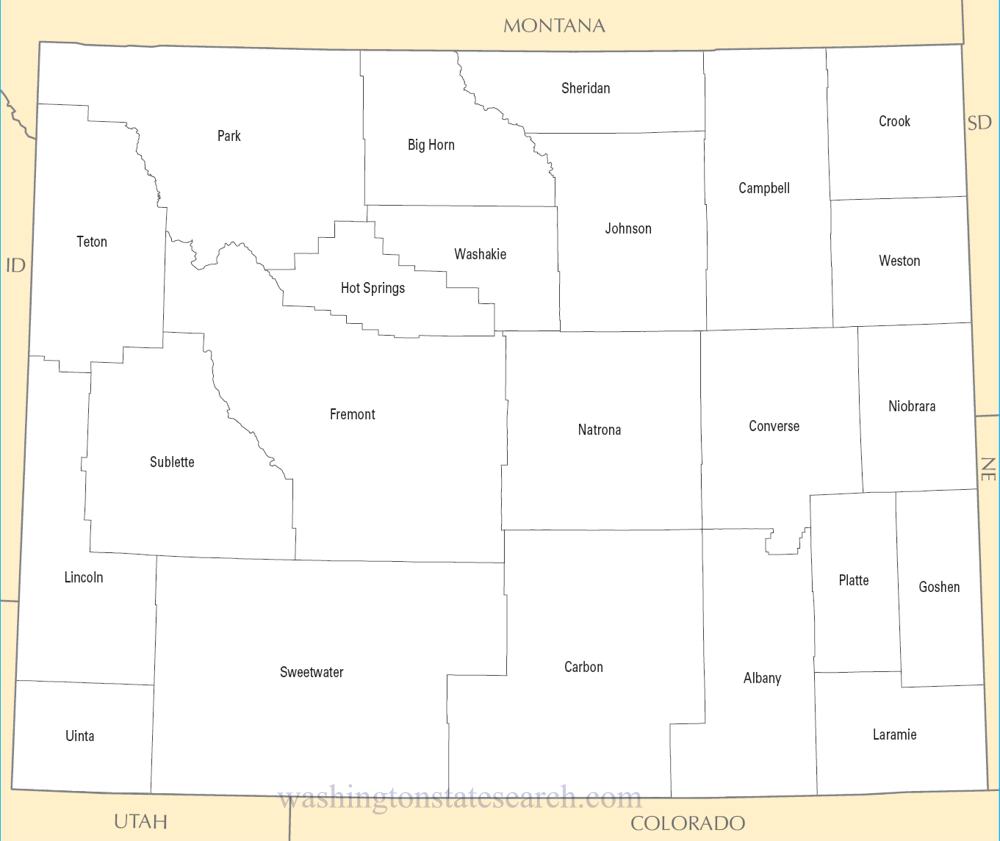
from the National Atlas of the United States
United States Department of the Interior
Wyoming State Map
Map search is available for a limited number of queries per session to manage costs. Be specific — search precisely for best results.
| State | Wyoming |
| Capital | Cheyenne |
| Country | United States of America |
| Counties | 23 |
| Latitude | 42.7456 |
| Longitude | -107.683 |
| Cities & Towns | 204 |
| State Map | Wyoming Maps |
About Wyoming
Wyoming's vastness unfolds in a dramatic landscape, a dominion of stark contrasts and enduring grandeur. To its west, the jagged teeth of the Teton Range pierce the cerulean sky, a formidable bulwark against the Pacific winds, while the ancient, geothermal wonders of Yellowstone National Park steam and bubble, a constant reminder of the earth's restless heart. Eastward, the Great Plains stretch out, a seemingly endless prairie where the wind sculpts the land into subtle undulations, punctuated by the rugged beauty of the Wind River Range. Rivers like the Snake, Green, and Yellowstone carve their paths across this immense canvas, nourishing the sparse vegetation and shaping the very character of the terrain, a place where sagebrush thrives under an immense, unblinking sky.
The history of Wyoming is a story written in the dust of ages and the whispers of the wind. Long before European arrival, Indigenous nations, including the Cheyenne, Crow, and Shoshone, traversed these lands, their lives intricately bound to the seasons and the movements of game. The arrival of fur traders and explorers in the 19th century marked a new chapter, a slow encroachment that eventually gave way to the enduring image of the American West. Cattle ranching took root, shaping the economy and the very identity of the territory, a rugged pursuit that tested the mettle of its inhabitants. This hardscrabble existence, etched into the very soul of the land, eventually coalesced into statehood in 1890, a testament to the resilience and independent spirit of those who chose to call this formidable territory home.
Wyoming's economy, historically tethered to the bounty of its land, continues to draw sustenance from its natural resources, though the nature of that sustenance has evolved. Ranching remains a vital thread, a continuation of a tradition that defines the state's rural character, with herds of cattle grazing under the wide-open skies. Yet, it is the earth's buried riches that have become a significant driver of prosperity, with vast reserves of coal, oil, and natural gas fueling industries and shaping the economic landscape. The raw power extracted from beneath the soil provides energy for much of the nation, a stark contrast to the quiet pastoral scenes that also define Wyoming. The quiet hum of machinery in remote oil fields, as much a part of the state's soundscape as the bleating of sheep, speaks to this dual nature.
The cultural character of Wyoming is one of quiet strength and an unpretentious embrace of the natural world. The pace of life here is often dictated by the sun and the seasons, a rhythm that fosters a deep connection to the land and a certain self-reliance. Sports, particularly at the collegiate level, hold a particular sway, with passionate fan bases cheering on their local teams. Music often echoes the wide-open spaces, from the twang of country guitars to the soulful melodies that seem to carry on the prairie breeze. Culinary traditions lean towards hearty, no-nonsense fare, reflecting the agricultural heritage and the need for sustenance in a challenging environment. In the quiet evenings, as the sky bleeds into hues of apricot and rose, one can feel the enduring spirit of Wyoming, a place where the vastness of the landscape mirrors the depth of its character.
Wyoming Cities and Towns by County
Carbon County
Fremont County
Laramie County
Lincoln County
Natrona County
Sweetwater County
Teton County
Wyoming County Maps & Location Information
This page provides an interactive Google map of Wyoming (WY) with Street View, satellite and terrain views, alongside links to detailed street maps for all 204 cities and towns across the state organised by county. Wyoming has 23 counties, with the state capital at Cheyenne.
Every locality page includes an embedded street and satellite map alongside live weather where available — combining National Weather Service forecasts with Open-Meteo graphical data including hourly observations and 7-day outlooks. Local and world news feeds, Wikipedia summaries and editorially written descriptions are included where available.
Location data is sourced from the USGS GNIS database and the SimpleMaps US Cities dataset, verified by coordinates rather than name matching alone.
