Manapouri Power Station
Home > New Zealand Information > Manapouri Power Station
Manapouri Power Station
From Wikipedia, the free encyclopedia
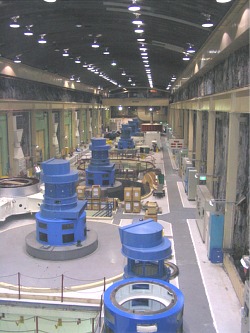
The Manapouri Power Station
machine hall (Feb 2005).
The Manapouri Power Station is an underground hydroelectric power station owned and operated by Meridian Energy Limited. It is the largest hydroelectric power station in New Zealand. The station lies deep in a remote area of New Zealand's South Island on the western arm of Lake Manapouri, in Fiordland (45º 31′ 17″ S 167º 16′ 40″ E. Most of the station's power output feeds to the aluminium smelter operated by New Zealand Aluminium Smelters Limited (NZAS) at Tiwai Point near Bluff, some 160km to the southeast.
The power station construction is a massive feat of civil engineering. The majority of the station including the machine hall and two 10km tailrace tunnels have been excavated under a mountain.
The station is located in the pristine Fiordland National Park. In the 1960s, environmental protests against construction galvanised New Zealanders from one end of the country to the other. The campaign to save the lake from being raised took on politicians and senior bureaucrats, and won.
Construction
The power station is housed in a cavern, excavated from solid granite rock 200 metres below the surface of Lake Manapouri. Two tailrace tunnels take the water that passes through the power station to Deep Cove and Doubtful Sound, 10 km away. Access to the power station is via a two-kilometre vehicle access tunnel, which spirals down from the surface, or a lift that drops 193m down from the control room above the lake. There is no road access into the site; a regular boat service ferries power station workers and tourists 35km across the lake from Manapouri town, at the eastern end of the lake.
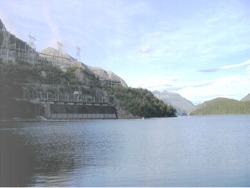
Switchyard and water intake of Manapouri
Power Station (Feb 2005).
Soon after the power station began generating at full capacity in 1972, engineers confirmed a design problem. Greater than anticipated friction between the water and the tailrace tunnel walls meant reduced hydrodynamic head. For 30 years, until 2002 station operators risked flooding the powerhouse if they ran the station at an output greater than 585MW – a long way short of the designed peak capacity of 700MW. A second tailrace tunnel, 10km long and 10 metres in diameter, finally solved the problem. Now water can flow away from the station at a greater rate, increasing the effective head so that the turbines could generate more power, without using any more water.
Environmental protest
The original plans for the power station development in the 1960s involved raising Lakes Manapouri by up to 30 metres, and merging Lakes Manapouri and Te Anau. A dam at the outlet of Lake Manapouri would have achieved this. As power station construction work progressed, the reality of the planned ecological damage became apparent to many New Zealanders, and protest became widespread and passionate. The Save Manapouri Campaign became an early New Zealand manifestation of the international awareness of the "environment" that came with the prosperity of the sixties.
"At its simplest, the issue was about whether Lake Manapouri should be raised by as much as 30 metres. But there was much more at stake than that. There were strong economic and engineering arguments opposing lake raising, and there were also legal and democratic issues underlying the whole debate. What captured the public's imagination across the country was the prospect that a lake as beautiful as Manapouri could be interfered with, despoiled and debased", writes Neville Peat.
In 1970, 264,907 New Zealanders, almost 10 percent of the population, signed the Save Manapouri petition. In the 1972 general election Manapouri was a significant election issue, and the Labour Government of Norman Kirk was elected on a platform that included a strong endorsement of the Save Manapouri ideals.
History
Early history
- The first surveyors mapping out this corner of New Zealand noted the potential for hydro generation in the 178 metre drop from the surface of the lake to the Tasman Sea at Doubtful Sound. The idea to build a power station was first suggested in 1904, but the remoteness of the location and the scale of the engineering task made any project infeasible at the time
- In 1926, the New Zealand Sounds Hydro-Electric Concessions Company obtained water rights from the government to implement a scheme to use power from Manapouri produce fertilizer and munitions. The idea was to use electricity to fix nitrogen from the atmosphere. The scheme did not proceed and the water rights lapsed
- In 1955, Harry Evans, a geologist with Consolidated Zinc Proprietary Ltd, identified a commercial deposit of bauxite in Australia on the west coast of Cape York Peninsula near Weipa at a location now known as Duyfken Point. Harry Evans was searching for oil, but he soon realised the significance of Weipa's red cliffs. He identified the red earth as bauxite, and determined it was of good grade and easily extractable. It turned out to be the largest deposit of bauxite in the world, yet discovered.
- In 1956 The Commonwealth Aluminium Corporation Pty Ltd, later known as Comalco, was formed to develop the bauxite deposits at Weipa. The company started investigating sources of large quantities of cheap electricity needed to reduce the alumina recovered from the bauxite into aluminium.
Construction history
In 1963 the construction project begins:
- February 1963, Bechtel Pacific Corporation wins design and supervision contract
- July 1963, Utah Construction and Mining Company and two local firms win tailrace tunnel and Wilmot Pass road contracts. Utah also wins powerhouse contract
- August 1963, a passenger liner the Wanganella is moored in Doubtful Sound to be used as a hostel for workers building the tailrace tunnel. During the 1930's she had been a top-rated trans-Tasman passenger liner, with accommodation for 304 first-class passengers. The Wanganella continues to serve as a hostel until December 1969
- February 1964, tailrace-tunnel construction commences. Breakthrough occurs in October 1968
- December 1967, powerhouse construction completed
- September - October 1969 sees the commissioning of the first four generators, followed by the remaining 3 in August - September 1971. First water flows through powerstation on 14 September 1969
- 1972 sees the station commissioned. It is then that engineers confirm the limitations of peak capacity due to excess friction in the tailrace tunnel
9 June 1997, work begins on the second tailrace tunnel.
- In 1998 the Robbins tunnel boring machine starts drilling, at the Deep Cove end of the tunnel. Tunnel breakthrough happens in 2001
- In 2002 the second tunnel is commissioned. Refurbishment of the seven generating units commences, upping their eventual output to 135MVA (121.5MW) each. This refurbishment continues today
Political history
- In July 1956 the New Zealand Electricity Department announced the possibility of a project using the Manapouri water, an underground power station and underground tailrace tunnel discharging the water at Deep Cove in Doubtful Sound. Five months later, Consolidated Zinc Proprietary Limited formally appoached the New Zealand government about acquiring a large amount of electricity for aluminium smelting
- 19 January 1960, the Labour government and Consolidated Zinc sign a formal agreement for Consolidated Zinc to build both an aluminium smelter at Tiwai Point and a power station in Manapouri. The agreement violated the National Parks act, which provided for formal protection of the Park, and required subsequent legislation to validate the development. Consolidated Zinc receives exclusive rights to the waters of both Lakes Manapouri and Te Anau for 99 years. Consolidated Zinc plans to build dams that would raise Lake Manapouri by 30 metres, and merging the two lakes. The Save Manapouri Campaign is born, marking the beginning of the modern New Zealand environmental movement
- In 1963 Consolidated Zinc decides it cannot afford to build the power station. The New Zealand government takes over. Electricity generated by the plant sold to Consolidated Zinc at basement prices, with no provision for inflation
- In 1969 Consolidated Zinc's electric power rights were transferred to Comalco Power (NZ) Ltd, a subsidiary of the Australian-based Comalco Industries Pty Ltd
- In 1970 the Save Manapouri petition to the government attracts 264,907 signatures
- New Zealand elects a new Labour government in 1972. In 1973 the Prime minister Norman Kirk, honours his party's pre-election pledge not to raise the levels of the lakes. He creates an independent body, the Guardians of Lake Manapouri, Monowai, and Te Anau to oversee management of the lake levels. The six Guardians are all prominent leaders of the Save Manapouri Campaign
- The Labour Party returns to power in the 1984 elections. The resulting period was tumultuous, with Labour's controversial ministers Roger Douglas and Richard Prebble driving rogernomics, a rapid introduction of "free market" reforms and privatisation of government assets. Many suspect the Manapouri Powerstation would be sold, and Comalco is the obvious buyer
- In 1991, the Save Manapouri Campaign is revived, with many of the same leaders and renamed Power For Our Future. The Campaign opposed selling off the power station to ensure that Comalco did not rehabilitate its plans to raise Lake Manapouri's waters. The Campaign was successful. The government announced that Manapouri would not be sold to Comalco
- 1 April 1999, ownership of the Manapouri power station transfers from the Electricity Corporation of New Zealand to Meridian Energy Limited
Specifications and statistics
Power station
- Average annual energy output 4800GWh
- Station generating output 850MW
- Number of generating units 7
- Net head 166m
- Maximum tailrace discharge 510 cumecs (1 cumec = 1000 litres per second)
- Turbines 7 x vertical Francis type, 250rpm
- Generators 7 x 13.8kV, 121.5MW / 135MVA
- Transformers 7 x 13.8kV/220kV, rated at 135MVA
Civil engineering
- Machine hall 111m length, 18m width, 34m hight
- First tailrace tunnel 9817m, 9.2m diameter
- Second tailrace tunnel 9829m, 10.05m diameter
- Road access tunnel 2040m, 6.7m wide
- Cable shafts 7 x 1.83m diameter, 239m deep.
- Lift shaft 193m
- Penstocks 7 x 180m long
